
We’re expanding our analytics stack with a new module that automates the analysis of cutting maneuvers. Building on our 5-0-5 test module, it now covers any cut, including 45° and 90° changes of direction.
In sports, a rapid change of direction can mean the difference between a game-winning play and a season-ending injury. Explosive cuts are essential to performance. There are also moments when athletes are at risk of non-contact injuries, particularly to the ACL.
Analyzing cutting mechanics is critical for injury prevention, rehabilitation, and performance. Cuts reveal overall movement patterns, for example how athletes manage braking forces, redirect momentum, and load the lower limb. Field-based tools like the Cutting Movement Assessment Score (CMAS) show that observable cutting technique relates strongly to knee loading and can highlight high-risk or inefficient strategies (Dos’Santos et al. 2019, 2021). Yet these assessments are often still manual and applying them at scale consistently is challenging.
Our new analysis module automates biomechanical evaluation of cutting maneuvers (e.g., 45° and 90° cuts) from smartphone video, delivering objective insights for performance testing, rehabilitation monitoring, and return-to-sport decisions. Isolated and composite metrics highlight movement execution and help identify outliers at a glance, while an interactive 3D reconstruction provides contextual, video-based analysis within a single platform.
Cutting places unique demands on the athlete that are not captured by linear sprinting or jumping tasks. Rapid deceleration, redirection of momentum, and re-acceleration must occur while maintaining control of the hip, knee, and trunk under high load. Small changes in technique can meaningfully alter how forces are absorbed and redirected.
Studies of cutting mechanics show that meaningful movement differences and asymmetries can persist even when performance outcomes, such as completion time, appear symmetrical, particularly after ACL reconstruction (e.g., King et al. 2018). Planned and unplanned cuts further reveal task-specific strategies and compensations that remain hidden in simpler tests.
For these reasons, cutting requires dedicated analysis. Looking beyond time and speed provides insight into movement quality, rehabilitation status, and readiness to return to sport, making cutting mechanics a critical complement to traditional performance tests.
Quality cutting depends on how an athlete brakes, positions the body, and redirects momentum. Foot placement relative to the center of mass, knee flexion during ground contact, and trunk orientation at the change of direction all influence how efficiently forces are absorbed and re-applied.
Control in the frontal and transverse planes is especially important. Excessive knee collapse or trunk lean can indicate compensatory strategies or asymmetries, even when completion time looks similar between trials or limbs.
While kinetic data would add further detail, many relevant aspects of cutting quality are reflected in movement patterns, timing, and segment alignment. Capturing these features provides meaningful insight into cutting performance, rehabilitation status, and progression over time.
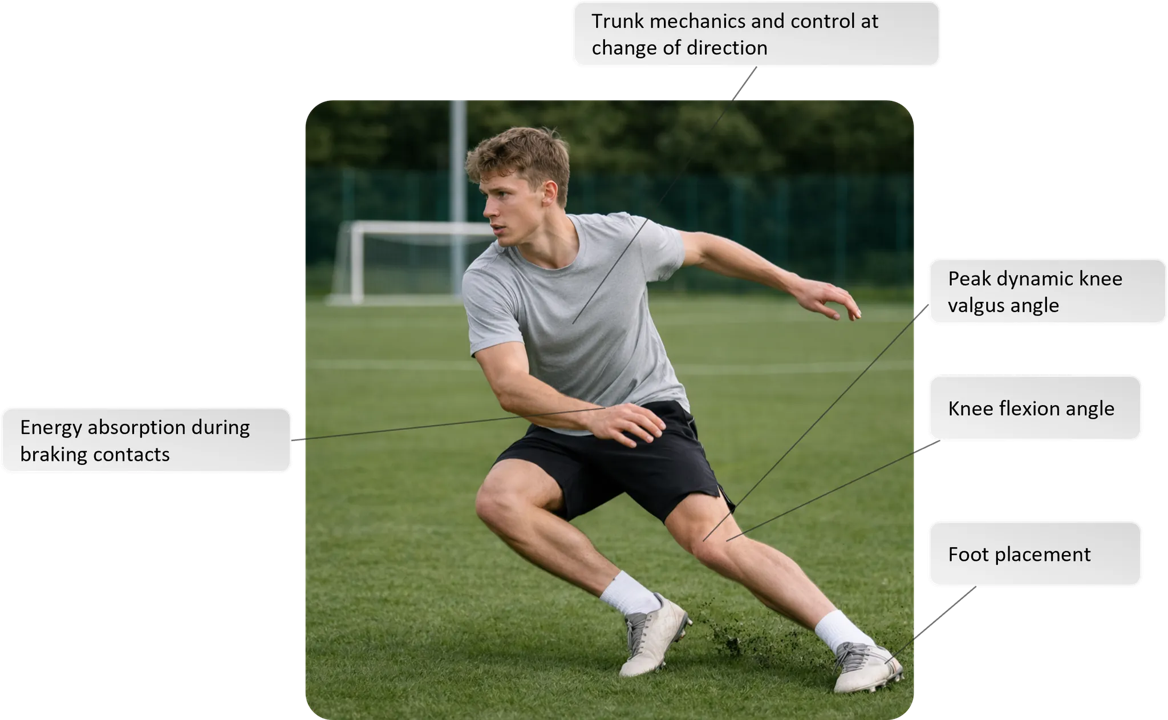
CMAS showed that cutting quality can be assessed through observable movement features such as foot placement, knee motion, and trunk control. These concepts remain central to how practitioners think about cutting technique in both performance and rehabilitation contexts.
Our cutting analysis module builds on the same movement principles, but quantifies them automatically from 3D motion data reconstructed from smartphone video. Instead of subjective scoring, key aspects of cutting mechanics are measured objectively and consistently across trials, limbs, and cutting angles. This approach preserves the practical value of CMAS while enabling scalable, repeatable assessment and facilitating contextual, in-depth movement analysis within our web platform.
Our cutting analysis module provides a clear picture of how an athlete executes a change of direction, going beyond completion time alone. Performance outcomes such as time and peak velocity are contextualized by how momentum is managed during the approach, plant, and exit phases of the cut.
By quantifying body positioning and joint motion at key moments - particularly during the penultimate and final contacts - the analysis highlights differences in braking strategy, lower-limb control, and trunk orientation. These details make it possible to identify asymmetries, compensations, or technique changes that may not be visible in raw performance measures.
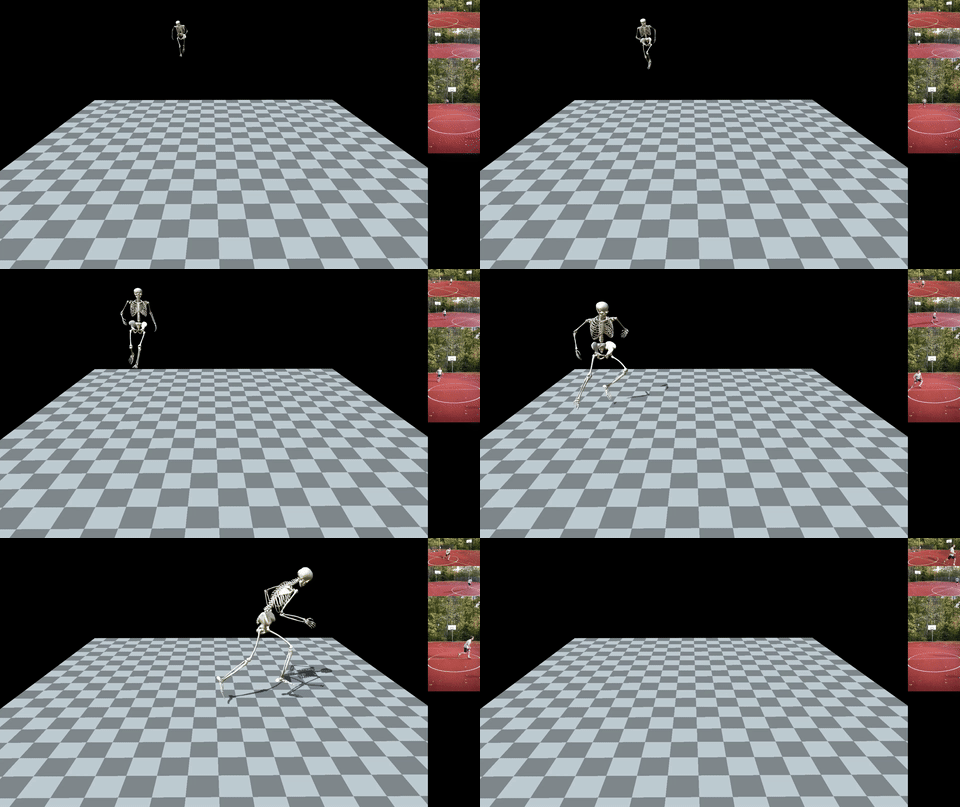
By quantifying key movement features consistently from video, the module makes it easy to monitor athletes over time, identify asymmetries or compensations, and evaluate the impact of technical or rehabilitation interventions. While controlled cutting tasks do not fully capture the unpredictability of game situations, they remain valuable for identifying suboptimal movement patterns under standardized conditions. At the same time, the analysis can be applied to open and unanticipated cutting tasks, enabling practitioners to assess movement strategies that more closely reflect real-world play. Together, this allows insights to be translated directly into actionable decisions—without requiring a lab or specialized equipment.

