Resources
Articles, research, and guides on movement analysis for clinicians, performance staff, and researchers.
Model Health and Kinvent Announce Strategic Partnership

Steve Oosterhof
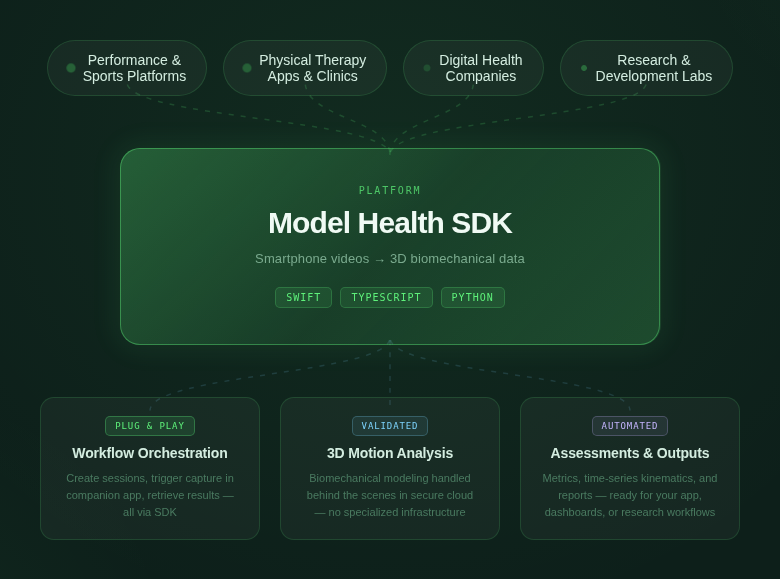
Introducing the Model Health SDK
Embed lab-grade motion analysis into your product. Built for applications in sports, physical therapy, performance, rehabilitation, or digital health.

Antoine Falisse
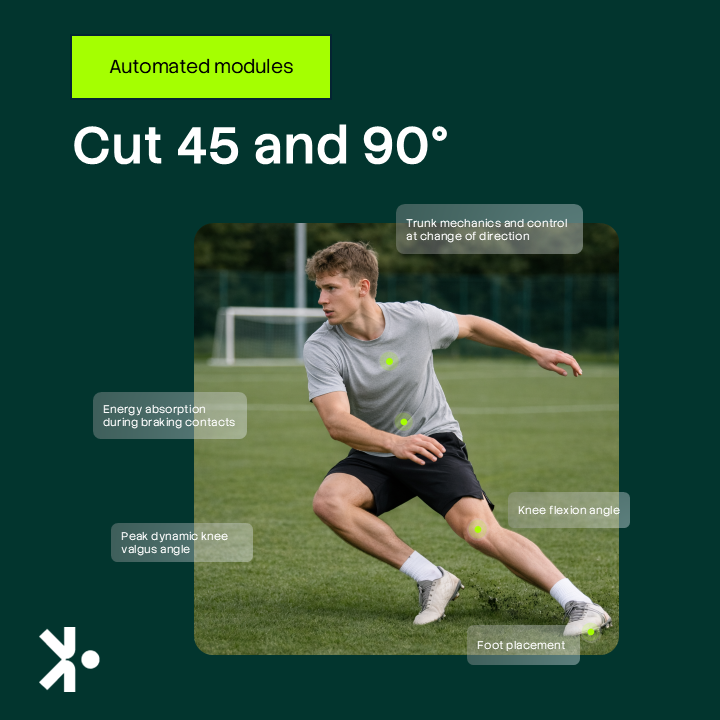
Cutting Edge: Automated Cut Analysis
We’re expanding our analytics stack with a new module that automates the analysis of cutting maneuvers. Building on our 5-0-5 test module, it now covers any cut, including 45° and 90° changes of direction.

Thomas Vleeschouwers

Model Health wins the eWEAR Health Prize at Stanford University
We’re thrilled to announce that Model Health has won the 2025 eWEAR Health Prize from Stanford University, an award recognizing cutting-edge innovation at the intersection of wearables, AI, and healthcare.
Antoine Falisse

Personalized gait retraining for knee osteoarthritis
For people with knee osteoarthritis, a precise change to their walking pattern can relieve pain and slow the degeneration of their cartilage. Scott Uhlrich, Model Health's Co-Founder and Chief Scientist Officer, recently published a clinical trial in The Lancet Rheumatolgy, with collaborators at Stanford and NYU Langone Health.

Nicolas Bellemans
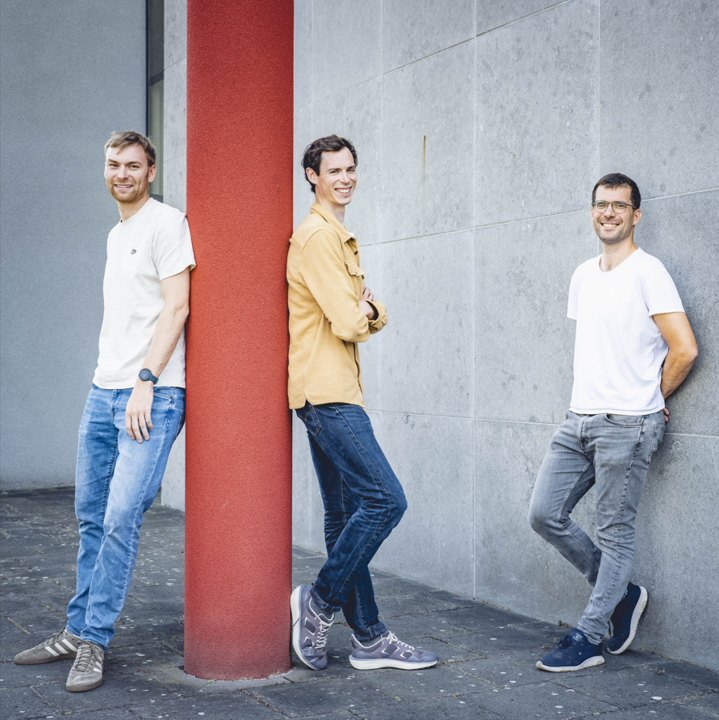
Model Health secures $1 million to boost physical health and human performance from smartphone videos
Model Health raises $1 million in pre-seed funding to bring lab-grade movement analysis from smartphone videos to sports clinics and organizations worldwide. The investment will be used to accelerate product development and attract world-class talents in the fields of biomechanics and AI to pursue its mission of enhancing physical health and human performance from smartphone videos.
Antoine Falisse
The research behind the results
Research highlights, peer-reviewed studies, and technical whitepapers validating or leveraging Model Health across clinical, performance, and reserach settings.
Research highlights
Peer-reviewed studies validating or leveraging Model Health technology.

Marker data enhancement for markerless motion capture
Building on OpenCap original breakthrough, Antoine Falisse et al. (2025), developed a more accurate and generalizable model, named "marker enhancer", to predict the position of 43 anatomical markers from 20 keypoints identified from video. We trained this model on a large database of 1,433 hours of data from 1,176 subjects.

Start collecting movement data today
See how Model Health fits into your clinical, performance, or research workflow. Create your free account and start analyzing movement in minutes.